We're glad you asked. Living and studying abroad will prepare you for life in ways that no other experience can. This isn’t just a trip to a foreign country—it’s a life enriching experience that will help you learn about yourself and the world we live in.
Read what other students had to say. Learn more about the Benefits of Study Abroad.
Many AFS participants begin the program with little or no experience in the language of their host country but learn to communicate at a basic level very soon. There is no better way to learn a language than by speaking it 24/7! Do your best to communicate, even if you are using basic words and phrases. You’ll get better each day and by the end of your semester or year abroad you’ll likely be fluent in the host country’s language. There are also AFS programs that offer language instruction to start you off on the right foot.
That said, some programs do have a language requirement
No, but because this is an academic program, we ask that you demonstrate that you will be able to do well in your host school. For this reason, our year and semester programs carry a minimum 2.8 GPA requirement on a 4.0 scale.
Summer programs do not have a GPA requirement, but students must have a passing GPA.
Back to TopAbsolutely. Gap-year Programs let you experience a new culture by either participating in an academic program or volunteering with a community service organization. We also offer a PanamaUniversity Study Program in that combines coursework with cultural programs. And some Summer Programs, such as the Mandarin Language Study Program in China, are open to high school graduates and older students.
Back to TopThe decision to study and live abroad takes a lot of thought. Your parents need to be involved and are bound to have questions. They'll want to know about AFS, how serious you are about the program, where you want to go, what you will do there, and especially what you hope to gain from the experience. We can answer the basics as well as offer you tips on approaching your parents about becoming an exchange student. We also offer informative online information sessions.
Back to Top
AFS recommends that you give yourself 2-3 weeks to complete your full application, but it’s really up to you how quickly the application can be finished. We have received applications in less than 48 hours from students responding to an application deadline.
The Full Application is in-depth and requires a visit to the doctor, a form to be completed by a school official, a letter of recommendation, and essays from you and your parents.
Be sure to submit your complete Full Application before the application deadline.
Here is what one student had to say about completing the AFS Full Application:
“When you receive the full application packet, the amount of paperwork involved may appear daunting ... However, with patience and perseverance, all of these steps can be accomplished, and the rewards can be immeasurable.” -Rebecca, Paraguay
AFS tries to accommodate students’ first choice country preference; however program acceptance is based on both eligibility and availability. Each program has its own set of eligibility guidelines, which are clearly outlined on the individual program pages. To avoid problems down the line, make sure you meet the age, GPA and Medical Evaluation Policies. Our programs do have a limited number of spots available and occasionally programs do fill before the deadline, so it’s always best to submit your application early.
Back to Top
We generally discourage students from bringing these items abroad for a variety of reasons. In the case of cell phones, rates may be very expensive or the phone simply may not work abroad. It is usually much easier for students to purchase cell phones or calling cards once they are already abroad.
In the case of having personal laptops, using them can lengthen the adjustment period for students and cause conflict with host families. Spending excessive amounts of time online can be a tempting escape during the cultural adjustment process and can cause students to withdraw from their host families. It often leads to students feeling more homesick or isolated. Excessive time spent emailing and chatting in English also delays the transition to fluency in the student’s new language. Furthermore, laptops pose a risk for theft.
While AFS does not put a specific limit on contact with friends and family back home, we do ask participants and their families to be conservative in their communications with each other while on program. As stated above, excessive telephone or online communications will often exacerbate a student’s homesickness and make the adjustment period more difficult. We also highly discourage family visits during the student’s time abroad as it is very disruptive to the student’s immersion experience.
Back to TopAFS will match you with a carefully selected host family, who will open their home and share their lives with you. There’s nothing like the experience of living as a member of a family and community in another country.
Back to TopNo. Once your application is accepted by the host country, AFS staff and volunteers begin looking for a community and family that are just right for you. By requesting a particular region or city, you will significantly limit the pool of potential host families. We encourage you to be as open and flexible as possible when it comes to your placement.
Back to TopMost students are hosted in small-to medium-sized towns or villages. Families in big cities often live in small apartments, so they don’t have a lot of room. Also, outside the major cities you often get a better feel for what a country is really like.
Back to Top
This is a common concern. The simple answer is yes, you’ll fit in fine–and we’ll help you out, too. Visit AFS on Facebook and connect with other students from the U.S. and abroad. Before departing on program, AFS provides “Culture Trek,” a resource to help you prepare for intercultural immersion. Before you travel, you’ll attend an orientation that will also help to prepare you for your study abroad experience.
Remember, the people you meet abroad will be just as curious about you and your culture as you are about them and theirs–which will give you plenty of opportunities to talk.
This depends on many different factors and is different for everyone. Some students learn of their placement soon after they are accepted into the program; some learn about their host community right before departure. However, most students learn of their placement about 1-2 months prior to departure.
The staff and volunteers in your host country are trying to find the best match for you and for the host family. They want this to be a positive experience for everyone and will work hard to make the best placement possible. Keep in mind that even if a great host family is identified for you, the placement won’t be finalized until a host school placement or community service project is confirmed in writing as well. This process takes time. But rest assured that AFS will get your host family contact information to you as soon as it is available.
Note that if you have placement restrictions such as allergies to pets or to the environment, if you require access to religious services, or if you have any dietary restrictions, the placement process will likely take longer.
Although we do our best to provide you with host family information at least two weeks before departure, this is not always possible. In fact, some students do not receive their information about their host families until right before departure. But your acceptance into the program is our guarantee that you will have a great placement that meets our quality standards.
It’s a great idea to bring a few small gifts with you for your host family and new friends. You don’t have to know your host family to start thinking about what to bring. Think of things that represent your community or state: a significant landmark, a famous local sports team, or a well-known company. Small gifts such as pins, pictures, mugs, t-shirts, or caps are popular items. Be careful not to overindulge. A small token of appreciation for your host family or new friend is plenty. Large and expensive gifts may make the receiver uncomfortable and should be avoided.
Back to Top
Maybe, but we cannot guarantee it. The amount and type of credit you receive is determined by your high school in the U.S. It’s important to talk with your teachers and guidance counselor before you depart to arrange your schedule. In most cases, AFS Participants have received language, history, or social studies credits. Be sure to keep a copy of any formal grades or transcripts you receive from your host school. It is your responsibility to obtain any written information about your attendance and grades in your host school before you return home. AFS cannot assist you with course or grade information after you complete the program.
Read tips on how to Get Academic Credit for your AFS Experience.
Possibly, yes, but we don’t recommend it. Other AFS Participants have reported that it’s best to take the SATs or PSATs before you go or after you return. Besides the inconvenience of getting to the testing location, your scores might reflect that you haven’t been speaking much English! To find out more about taking the SATs abroad, consult the College Board website.
Back to TopWhile many students do attend high school with their host siblings, this is not always the case. Your school placement depends largely on your age and the ability of AFS to secure a spot for an exchange student. Occasionally, host siblings will attend a private school that is willing to accept exchange students, but at an extra cost. Having a school placement is part of your tuition, so AFS will always offer you a school placement option with no additional costs, but you may have the option of attending a private school for an additional cost if you wish to do so.
Back to Top
AFS will purchase your international plane ticket and will notify you of your international travel itinerary approximately 4 weeks before the program begins. The travel dates listed on the website are approximate and subject to change by as much as 2 weeks so do not book your domestic travel based on those dates.
You are responsible for making travel arrangements to and from the International Gateway City (New York, Miami, Washington, D.C., or Los Angeles). The domestic travel costs are not included in your program tuition.
We will ask that you arrive one day prior to your international departure so that you can participate in an overnight Gateway Orientation with the other students in your program.
No, after the overnight Gateway Orientation in your International Gateway city, you and the other participants in your program will fly together between the U.S. and your host country. In some cases you will travel with an adult chaperon, especially when there are more than thirty-five of you traveling together.
Back to TopResearch your host country to learn more about the climate, how teens dress, and any school dress code that might be required. The best advice from other AFS Participants is to take things that you’re comfortable wearing. Avoid trendy outfits—chances are they won’t be in fashion in your host country and you may feel out of place.
Back to Top
We recommend that you pack a small carry-on bag with a change of clothes, a towel, and personal toiletries. In some cases access to your luggage is restricted during the arrival orientation and it’s important to have these items with you.
Helpful hint: Clothes dryers may not be available in every household—drip dry is the way to go. Also bring one or two nice outfits for special occasions.
Once packed, weigh your luggage to make sure that it is less than 44 pounds. Even though most international carriers permit you to take more than 44 pounds of baggage, you may have to take a domestic flight within your host country. These flights often have more stringent rules regarding baggage. If you chose to bring additional or overweight bags, you will be responsible for all extra fees that may be charged by the airlines.
For safety reasons, most airlines have introduced stiffer carry-on baggage rules. Keep your carry-on bags limited to a backpack or something similar in size. The carry-on bag is limited to 8 inches x 16 inches x 21 inches; and a weight of 22 pounds. Most airlines will permit passengers to carry a purse, umbrella, or camera in addition to one carry-on bag.
Helpful hint: Remember that you will have to carry your own bags. Once your bag is packed, try carrying it around the block twice quickly. If you can’t make it, it’s time to re-pack!
After you arrive in your host country, you and the other participants will collect your luggage and pass through customs. Once through, you will be met by AFS staff and volunteers in the host country who will escort you to the arrival orientation site.
You’ll then take place in an international orientation that will help prepare you for you cultural adjustment. Depending on the host country and program, this arrival orientation can last anywhere between one day and one week.
This depends on the distance between your host community and the arrival orientation site. In some cases, you will be placed close enough for your host family to pick you up after the orientation. In others, you may have to travel by bus, train, or plane to your host community first. You’ll often travel together with other AFS Participants placed in your community or nearby. AFS Volunteers and Staff are there again to meet you at the station or airport.
Travel to other countries is permitted only in special circumstances and with advance approval. The AFS program promotes learning about your host country and its people, and traveling outside of it can disrupt the AFS experience. In some cases you are allowed to travel with your school group or with an adult chaperon, but you must get permission from AFS-USA, AFS in your host country, and your parents.
Back to TopNo. We’ve learned from experience that visits from home are very disruptive to your cultural immersion and adjustment.
In some cases, your parents may come visit you abroad but only after the program ends.
Back to TopWe don’t recommend it. Spending time abroad and with your host family during the holidays will give you a unique perspective on the cultures values of your host country.
Back to TopA passport is an international form of identification showing a person’s nationality. It is required of all individuals traveling internationally. If you still do not have a passport, you should obtain one now. Obtaining a U.S. passport generally takes about 6-8 weeks. The longer you wait to take care of this detail, the more expensive and frustrating the process. Not having a passport can also jeopardize your chances of going abroad since you can’t travel anywhere without one. AFS requires that your passport be valid for at least six months beyond your intended date of return.
Back to TopIf you have not already applied for a passport, apply now! It can take six to eight weeks to receive your passport and you will need it in order to obtain your student visa. Apply for a passport online or at your local post office. If you already have a US passport, make sure it is valid for at least 6 months after the end of your program. If not, start the renewal process immediately.
Back to TopA visa is a stamp or other notation generally placed in your passport that will allow you to enter and temporarily reside in your host country during your program. A visa is required for all Year and Semester Programs and for many of the Summer Programs.
Back to TopThe answer to this question depends upon your destination. For some countries, the process is straightforward and relatively quick, but for other countries, obtaining a visa can be very time consuming and quite expensive. For this reason, please review the Visa Comparison Chart to learn about visa requirements for the programs and countries that are of interest to you. You will need to begin preparations for obtaining your visa upon receipt of your country specific visa information. This will be posted online and emailed to you approximately 6-8 weeks prior to departure.
Please note that some visa applications require you to apply in-person at your host country’s regional consulate. You may be required to travel to the consulate in order to do so.
Also, if your program requires you to apply for a student visa, you may have to submit your passport to the consulate along with your visa application. For this reason, we suggest that you not plan any international trips in the months prior to your departure on an AFS program.
Back to TopIt costs about $135 to obtain a passport. It will cost more if you need to receive it faster. Some visas can be very expensive. Visa application fees can range anywhere from being free of charge up to $1000. It is important to remember that in addition to the actual fees charged by the Consulates, some applications require that documents be translated, notarized, and/or legalized. You will be required to pay for these services as well. If you are concerned about visa costs, talk to your Application Advisor about programs and countries with low visa fees.
Back to TopNo, your program fee does not cover any of the costs related to obtaining your passport or visa.
Back to TopVisas are obtained through the Consular Offices of a country’s Embassy. While most Embassies are in Washington DC, there are a number of Consulate Offices located throughout the U.S. Each office has jurisdiction over certain states. If you are required to work with any of these Consulates to obtain your visa, we will provide a listing of contact information and general visa information from AFS.
Please note that some visa applications require you to apply in-person at your host country’s regional consulate. You may be required to travel to the consulate in order to do so.
Back to TopAFS will provide you with visa information to give you an idea of the process. Our visa information tends to be very general because it is not AFS who issues your visa—it is the Embassy or the Consulate of the country where your program will take place. It is critical that you obtain detailed information on the visa process for your program directly from a Consular Officer from your host country. While AFS verifies requirements and fees from all Consulates before the start of our programs, we have found that these requirements can change suddenly without notice, and that requirements can sometimes vary from one Consulate to another across the U.S. AFS will provide you, when necessary, with visa support documentation. This documentation usually consists of an official letter from AFS stating that you have been accepted on our program, and documents containing your host family and school placement information from overseas. Sometimes these documents have to come from the appropriate AFS Partner Country, so we cannot always control when we will be able to send them to you.
Back to TopUnfortunately, at times these scenarios do happen. Since Consular Officials issue visas, AFS has no control over these situations or the overall process itself. When these situations occur and aren’t the fault of the student, (i.e. applying for a visa late or taking trips out of the country prior to the start of a program) AFS will reschedule the international flight once the visa has been granted. If you are denied a visa, AFS will do everything possible to offer you an alternative program at that time. Since you will not be able to travel before you have secured your visa, it is very important that you do purchase a refundable and changeable domestic ticket to your gateway departure city. If your departure has to be delayed due to your visa, you will be responsible for changing your domestic ticket and for any penalties the airline charges. If you do not have your visa within 72 hours of scheduled departure will likely be asked to reschedule your flight for a later date. You should not let these issues deter you, but rather guide you in choosing a country and program. As mentioned earlier, not all programs require visas and some visas are easier to obtain and less expensive than others. In the end, we are sure you will agree that the experience of complete immersion in another culture was worth your efforts.
Back to Top
Yes, if you’re willing to help raise the money you need. AFS Global Leaders Scholarship offers both need and merit-based aid through our program. Fundraising is also important. There are many community organizations that will help a good cause (like your AFS experience), and we’ll give you tips on getting their support. Garage sales, car washes, and letters asking for sponsors are just a few strategies that work. Check out the AFS Fundraising Wiki or join a fundraising conference call to learn even more fundraising tips.
Read more about covering your AFS tuition.
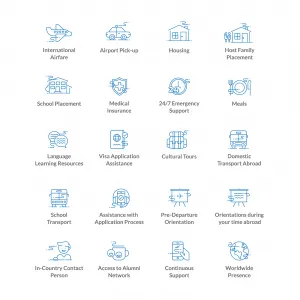
Check out What Your AFS Tuition Covers.
Back to TopLearn more about Where the Money Goes.
Back to Top
AFS requests that a $900 deposit be submitted with your Full Application. Your application will be sent to the AFS host country only after your complete Full Application and $900 tuition deposit have been received. AFS incurs expenses on your behalf and this deposit shows us that you are committed to participating. The remaining balance of your tuition must be received before you will be allowed to participate in the program.
For more information, see our Payment Schedule and Refund Policy.
The answer to this question depends on individual preference, as well as one’s individual bank. Many students find it easiest to use a Debit card from their home bank, however be sure to research ATM or other fees associated with your bank in your country of study. Other students find it easier to open a new bank account in their host country. Once you get closer to departure you can research this independently.
The amount of spending money needed also depends on student habits as well as the exchange rate in their host country. Generally, spending money needed ranges from $100-300/month. When a student is departing for their host country, their meals and lodging will be covered. However they should bring enough money to cover incidentals during travel and the first few weeks of their stay, in the event they are not able to go to a bank immediately upon arrival. They can exchange money to their new currency at their home bank or upon arrival.
There are AFS offices, staff, and experienced volunteers in host countries to support you during your experience. There are many layers of support beginning with a host family. In every case, each student has an assigned AFS local volunteer who is trained in providing support to a student. Additionally, AFS has paid Support Staff in each country office and an emergency Duty Officer system available through an emergency hotline after business hours.
Read more about how AFS provides for your safety while abroad.
Yes. AFS has three rules that all participants must agree to:
All participants must be law abiding in their host country. There may be country-specific rules that apply. There also are limits on traveling independently. In a new environment, it’s important to be more aware than you might be at home. And remember: you are a student ambassador for the U.S., so it will be important to act respectfully toward others and to give extra attention to being culturally aware. Students may be sent home for breaking rules or laws, or for persistent behavioral issues.
Back to Top
It is part of our commitment to your safety and welfare. This additional coverage ensures that, in an emergency, you can be treated as soon as possible, anywhere in the world. This secondary medical coverage is a prerequisite for your participation and is included as part of your program tuition.
Learn more about our Secondary medical insurance.
The majority of AFS countries do not require special immunizations. AFS recommends immunizations based on the information provided by the Center for Disease Control and Prevention. All AFS Participants should be immunized against the seven childhood diseases: measles, mumps, rubella (MMR), diphtheria, pertussis, tetanus (DPT), and polio. We recommend that you check with your family physician to determine which immunizations are appropriate based on your medical history.
Back to TopCan't find the answer to your question? We're happy to help. You can ask us in all sorts of of ways. Call us at 1-800-AFS-INFO and speak to an AFS Advisor. Email us at afsinfo@afs.org. Or ask us a question directly on our Formspring account, and we'll get back to you ASAP.
Back to Top